Showing posts with label colombia travel blog. Show all posts

25 January 2013

Introducing our new Colombia Travel Blog

It's been almost 3 years since I started this blog which evolved to an amazing collaborative Colombia Travel Blog by a wonderful team of expats in Colombia , we have just launched our latest version , remember to follow us here:


Abrazos. Marce


8 May 2012

We are Official Colombia Travel Bloggers!

Hi all,

This is just a quick reminder to all of you that we have moved  our blog here ---> Colombia Travel Blog and that there are very exciting things happening at the See Colombia Travel headquarters in Bogota, one of them is that last March we've been selected as Official Colombia Travel bloggers. You can see our Colombia.Travel entries here: See Colombia's Official Colombia Bloggers page.


 Abrazos!

Marcela

8 April 2011

Rio Bogota ( Bogota River ) .... the second most polluted river in the world :(

Hello all,

This is a folow up post to the introduction to the Teqauendama Falls post I did a while ago, unfortunately this is not about the outstanding scenery of the falls  but about the extremely poluted Rio Bogota that affects not only what should be one of Colombia's touristic spotlights, but also - and more importantly -  represents a serious health hazard to the unprivileged people that live at its shores.

A phrase by The International Development Research Center, Canada says it all:

“The Tequendama Falls has the dubious honour of being the largest wastewater falls in the world…Liquid wastes from the city are flushed untreated into the Bogotá River at the lower edge of the sabana, a few kilometres upstream of the Tequendama Falls. Downstream from Bogotá, the river is filled with sewage…”

Besides promoting touristic destinations  in Colombia, my Colombia Travel Blog also wants to help create conciousness about how important is to respect the enviroment and our frail eco system when visiting a site. It is a shame that we have the doubios honor to have the second most pulluted river in the world , as supporters of Fundacion Rio Urbano ( a Waterkeeper alliance member)  we joined a group of Rio Urbakno members, See Colombia Travel staffers and an American friend I met in Bogota a few days before during a Trek . The objective was to realize how seroious the situation of the river is as well as help us understand the many reasons that have caused this eco tragedy.

Thanks to my friend Lee Pera for letting me reproduce her post, you can read her whole chronicle about our visit below ,  and you can find her  Bogota blog here:

23 March 2011

ColOmbia is not ColUmbia!

Hello all,

Ryan Wallace from the Colombia Travel and Living blog is an English expat in Colombia that is falling in love with our country one post at the time... he was kind enough to let me reproduce his entry about " ColOmbia or ColUmbia" , a common mistake made by english speaking people, especially in North America...every time I hear it I try to correct it, but there's just too many people confusing " Columbia" with 'ColOmbia" , so here it is , hoping it reaches as many people as possible :)

Abrazos!

Marcela


Columbian Vacations

Colombia. With an 'O'.
Of all the misconceptions about Colombia, there is one that seems as though it will always remain pervasive and almost impossible to change; a dark cloud looming over the country that may never be cleared. For decades, Colombians have sought to teach us English-speakers the truth about their country, but to little avail and the problem remains. On this blog, though, we’re dedicated to spreading the good word about this beautiful country and attempting to correct the mistaken ideas that haunt the country as a whole – especially this particular one. The problem?
Columbia.
As a writer on this blog I see plenty of evidence of this misspelling. I see searches for “Columbia Vacations”, “Beaches in Columbia”, “Columbia Hotels”, and many more. From our English-language perspective, it’s easy enough to understand the mistake. After all, the country’s name is derived from Italian explorer and discoverer of the Americas, Cristoforo Colombo, a name that is pretty much always Anglicized in our schoolbooks as Christopher Columbus. On top of this, the US city Columbia, South Carolina is named after the same explorer, as is Columbia University in New York, leaving us with the simple conclusion that the country, too, must be spelt the same way.
Not so. What is now known as the Republic of Colombia was named as such in 1886, after Venezuelan revolutionary Francisco de Miranda used Colombia conceived of the name Colombia as a reference to the countries of the New World. Because of this, Colombia the country is spelt with an ‘O’ in whatever language you’re speaking.
So if you know anyone who’s still searching for “Columbia Vacations”, or “Columbia Holidays”, be sure to tell them right away to correct themselves before they actually get here. Not only will Colombians be very happy they can spell their country correctly, we’re also pretty sure if they book a Columbia vacation expecting the beautiful beaches they’ll find here in Colombia, they’re going to be sorely disappointed.
Ryan

3 March 2011

Anthony Bourdain in Colombia

Hi all!  I just came back from a wonderful trip around Colombia so I've got tons of material both for my Colombia Travel Blog as well as for my ongoing Colombia Project!

For now I want to leave you with a 3 part video of Anthony Bourdain's show "No reservations"  from a couple of years back... what I love about this episode is the fact that Bourdain not only discovers the vast and rich Colombian Gastronomy, but is also the perfect example of a traveller with prejudices about Colombia that suddenly realizes that instead of being in the horrible place he heard about, he's actually discovering an almost untouched country to be exlored. My favorite quote: "Its ludicrous this place exists and that evervory doesnt wanna live here!"

Enjoy !


Abrazos,

Marcela

29 January 2011

Tierra Caliente, Colombia (?)

Some months ago, thru Trip Advisor I met an Argentinean girl called Lorena that just had moved to Colombia and she started visiting my Colombia Travel Blog regularly. Amongst many other questions she asked me there was one that caught my attention , she wanted to know how to get to the place called “ Tierra Caliente” ( “ Summer Land” ) that everyone seemed to recommend as a very relaxing destination but that no one seemed to be able to tell her how get there. I couldn’t believe what I was reading and I just laughed , but then I realized that for us Colombians this  is pretty obvious , but for a foreigner “ Tierra Caliente” means nothing. 


I replied back basically saying that there is no such  place as “Tierra Caliente” , is just that due to Colombia’s position within the Equator and in the Andes  every town or city  below 1000 meters a.s.l is warm(ish)  and therefore called “Tierra Caliente”  by all of us living above that altitude.

Bogota is at 2600 m.a.s.l so we have a colder average than many regions in the country, which means that ,   as an example, we don’t have outdoor swimming pools  , so on weekends  is usual for us Bogotans to head of the city in search of “ Tierra Caliente”
which can easily  be found at only a driving hour away from Bogota .


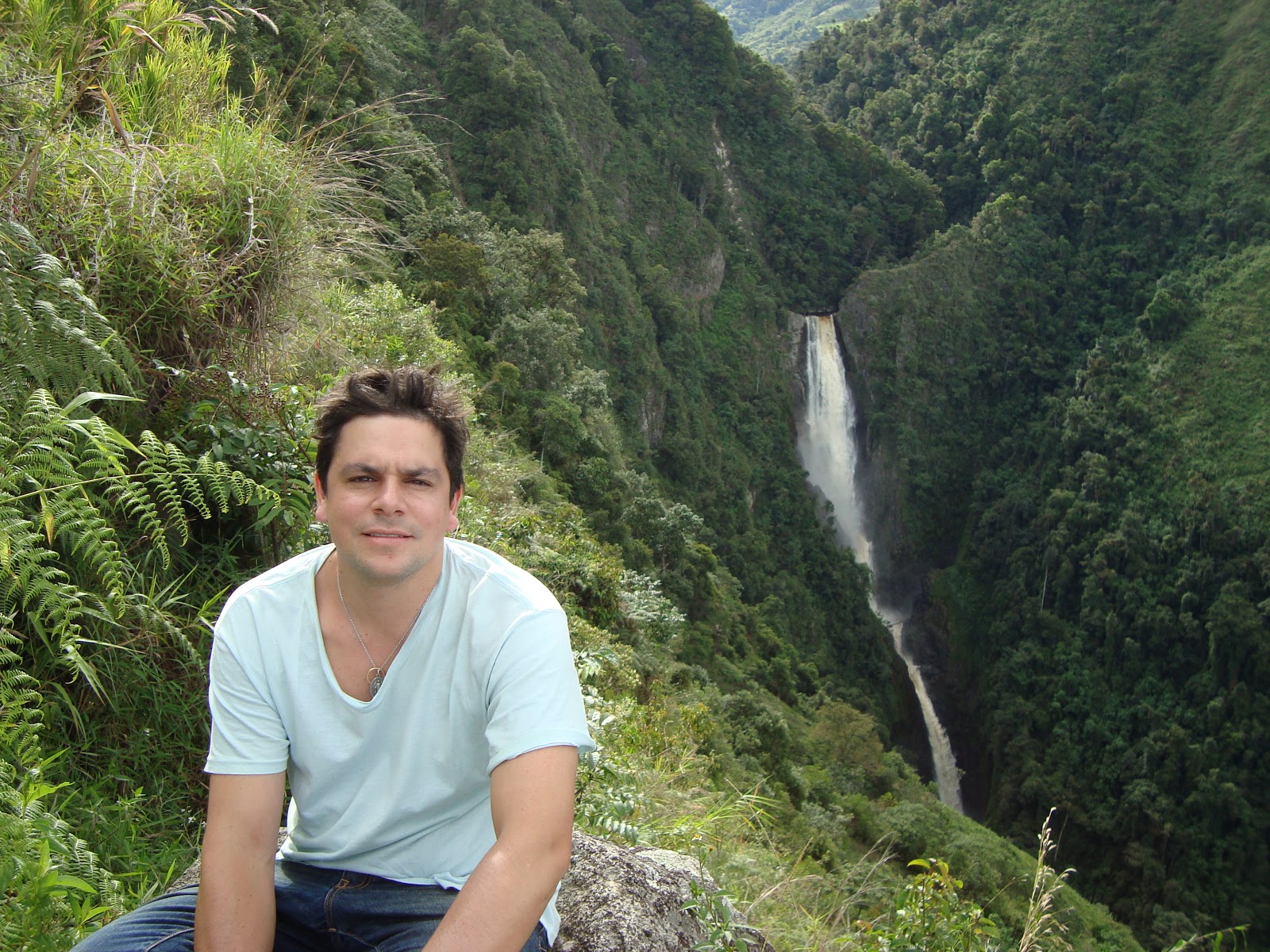
This entire introduction is to put give some context of a day trip we did out of Bogota last weekend to Tierra Caliente, and more specifically to the legendary Tequendama Falls, a 515-feet high waterfall on the Bogotá River, located about 18 miles southwest of Bogotá in the municipality of San Antonio del Tequendama.  My fiancé, who’s not from around here, had read about el Salto del Tequendama when he was a little kid in a comic book called “ Joyas  de la Mitologia”  and he didn’t  even remember that the story was set in Colombia, but  had always remembered  the legend of Tequendama, which  involves the pre-Columbian  Muiscas  and a white bearded deity (Bochica)   who created the Fall with his golden scepter. So when I told him that el Salto del Tequendama was less than hour away from Bogota, he jumped in the car and we headed in search of his childhood memories…..  the trip was a mixture of awe due to the outstanding scenery and a mixture of sorrow and  disappointment  due to the horrible pollution of the Bogota River ….. More about that in my next  Colombia Travel blog entry.

Abrazos,

Marcela


12 January 2011

Colombia featured in The Sunday Times!

Gathering onformation for a coming post of my Colombia Travel Blog, I recently came across an article  in the prestigious British newspaper The Sunday Times entitled Colombian Gold. I worried, of course, that it would be riddled with safety recommendations and warnings that were meant to reassure people but really just bolstered the image of Colombia as a dangerous destination. I shouldn’t have worried at all. Stanley Stewart’s article is an overwhelmingly positive look at Cartagena, and proof of the growing interest in Colombia as a travel destination.


1 January 2011

Christmas Lights in Colombia


Is that time of the year again and I’ve been meaning to relive one of the many special Bogotan traditions: to visit  Monserrate,  the tallest and most well known  mountain that frames the city of Bogota, by night . During December visiting Monserrate is especially beautiful because of the Christmas lights that decorate the whole mountain and the church that lies on top of the crater of our now dormant volcano that has become a

27 December 2010

The most popular Colombia Travel Blog 2010 Entries.

Hello all!

It’s been more than a month since I last posted an entry in my Colombia Travel Blog, sorry about that! Just as it happened last December when I wrote about Christmas in Bogota,  many many things have converged during the last weeks of this year taking me momentarily away from my blogging activities… all very good things though!

One of them is that I just came back from a wonderful trip to the Galapagos Islands in Ecuador that was really breathtaking and that I’ll tell you about in more detail in a coming post. I’m also in the final stages of planning yet another round trip through Colombia during January, this time focusing in the Colombian Caribbean coast, so expect a lot of new entries about those destinations during 2011.  Also, and related to that trip, I am very happy to tell you that l will  very soon be able to  announce the Colombia project I have been so hardly working on during the last months …. And all of it thanks to this blog!

And because this Colombia Travel blog has given me that much during 2010, I wanted to list the most visited entries during the last 12 months according to Google Analytics:


Although it was published a few days after Christmas 2009 many people have googled about Colombian Christmas traditions, specially about the very Colombian Noche de las Velitas.

4. Bomba Estereo, my favorite new Colombian band.

I discovered this band thru a Belgian friend in Buenos Aires at the beginning of the year…. Now it seems that a LOT of people consider Bomba Estereo  as their new favorite Band, they even won the 2010 MTV award in that category, and I  had the chance to see Bomba Estero in Argentina live too a couple of months ago .


Unsurprisingly, many of you reached this blog by looking after the best joints to party at in Colombia, this posts talks about my top 5 rumba places in Bogota, my home city.


My personal favorite, this little post created some buzz around travel websites and was republished in many sites and blogs alike even generating some controversy in a number of travel  forums.  Two main things to highlight about this entry:  1) Only listen to people that have actually traveled to Colombia when looking for advise on coming here and 2) Use your common sense as in any other place in the world: Colombia is not more dangerous than any other country in Latin-American.  

1. Top 5 Hidden Destinations in Colombia

Cartagena, Bogota or Santa Marta are amazing destinations, but it seems that people are also looking for more off the beaten path places to discover, here you can find my top 5 alternative Colombian Destinations 
               
Abrazos,

Marcela

19 November 2010

San Agustin Archaelogical Park featured in today's Bing frontpage!


Hi All! This is  a short last minute post... I was reviewing my Colombia Travel Blog's  traffic charts  and I realized that the most sought after keyword today  is "San Agustin Archaeological Park"  and the  Top Hidden Colombia Destinations  entry the most popular one, which is strange, because what I usually get is tons of hits on the topics of "safety in Colombia", Cartagena, Medellin, "Travel to Colombia", etc...

Intrigued by that fact,  I researched a little more and discovered that today's Microsoft's search engine ( Bing)  frontpage featured a beautiful picture of one of  San Agustin Archaeological Park's statues!  This is so amazing! One of the most well keeped secrets of Colombia in an extremely high traffic page!!!! , as I have said before the San Agustin Archaeological park is an amazing  collection of  hundreds of  impressive precolumbian head stones in a huge natural area  of southern Colombia , bigger than  - for instance - the  Machu Picchu national park in Peru.

So I thought I'd take the opportunitty to give you some more details on San Agustin archaeological park:


How to get to San Agustin Archaeological Park

The closest mayor town is Neiva south of Colombia. From Bogota you can fly with Aires for about US$40 and get there in about 1 hour or, take a bus from Bogota’s bus terminal and enjoy the 326 ks and 6 hours of beautiful scenery.  Once there, you need to take another bus, but this time going to Pitalito (212 ks) and once there take a local bus (US$0,5) or a taxi (US$3) to San Agustin. The bus from Bogota to Neiva costs about US$15 and from Pitalito to San Agustin another US$10.
Entrance fees are: free for kids under, from 7 to 17 years old is COL$5.000 (US$3) and COL$10.000 (US$6) for adults.

What to bring 


It takes about 3 hours to complete the park circuit, so I recommend to take with you:

- A day pack
- Plenty of water
- Sun screen and a hat
- Walking shoes and light clothes, the average temperature there is 18 centigrades.


What’s there

Apart from the main park – San Agustin – there are two more archaeological sites closed by called Alto Lavapatas y el Bosque de las Estatuas which you can also visit paying a little bit extra; and a second one called Tierradentro located very closed to a town called La Plata 126 ks from Neiva.

But that's  not all… from Neiva you can also visit the amazing Tatacoa desert too!

Abrazos,

Marcela

How do you get married in Colombia? : A summary of all paperwork you need for your wedding with a Colombian.

Hello All,

Lately, I’ve been doing some research  on a certain topic I’ll tell you about in a future post =) ...  and  coincidentially (is there such thing as coincidence?) I have also found that its  a topic that has been asked about quite a lot in Tripadvisor recently. What I’m talking about is  how to marry a Colombian or how to get married in Colombia.  It seems that Colombia is not just opening to the world of tourism but also to loooove and therefore to international marriages.


So, if you or someone you know is planning to get married in Colombia these are the legal requirements to do it:

Civil wedding in Colombia - even if you are getting married in church you need the following:

Under Colombian law, a foreigner doesn’t require a special visa to get married in Colombia. The couple would have to identify themselves with a current passport and a valid visa (foreigners) and the natioanl ID - cedula de ciudadania - (locals) and the following documents:


1. Authenticated passport/ cedula de ciudadania photocopy.
2. Authenticated birth cerificate with a validity no longer than 30 days for Colombian naionals and 90 days for foreigners. If the certificated was issued in a language different from Spanish, it should be translated by an official translator and legalised before the local Foregin Ministery (apostillar)
3. Certificate of no impediment (AU) or Unmarried state certificate if any or both are foreigners.

Special documents for exceptional sircumstances.

1. Cerified copy of marriage annulment when applicable
2. If widow/ widower, certified marriaged certificate and spouse’s death certificate
3. If divorced, certified copy of previous marriage certificate with divorce clause


Catholic wedding in Colombia

If you decide to get married with a Colombian under the Catholic church  you will need - on top of all of the above - the following documents:

1. Certified baptism certificate issued no more than 90 days before the marriage date
2. Certified confirmation certificate. If it is issued in a language different from Spanish, it should be translated by an official  translator and legalised before the local Foregin Ministery (apostillar)

If any of the two is a non catholic,

1.certificate from her/his own church. Again, if the document was issued in a language different from Spanish, it should be translated by an official  translator and legalised before the local Foregin Ministery (apostillar)
2. Certificate of no impediment writen by two members of the family before a priest and certified by a member of the church specifying:
a) How long the couple have known each other
b) That non of them have been married before or if any has been married before, the reason why they got divorced

If any of the two is Catholic and has a previous marriage should  also include

1. Annulment certificate
2. Divorce certificate
3. And /or death certificate of previous spouse

If any of the two was previously married under the catholic church and then divorced, but the expartner is still alive, will not be able to get married again unless the previous marriage was invalidated by the catholic church.

Remember that ALL documents should be translated by an official  translator and legalised before the local Foregin Ministery (apostillar).

I wish I could say this is the end.... but is not the case just yet... we still are unmarried at this point ... so what to do next? Here we go.

If you are having just a civil wedding is not necessary for both to be present when handing the documents in. The foreigner should send a power of attorney (again translated and certified) giving power to present his/her documents and to fill and sign the required form  on his/her behalf.

The “Colombian”, should take all these documents to a Notaria  (here is a list of notarias in Bogota ), fill in a form pay the fee - aprox COL$140.000 - US$80 and wait for a confirmation that all documents are in order.

If everything is going according to plan, they will publish an “edicto”. What this means is that the Notaria will let the community know your intention to get marry so, if someone has anything against this union, they have five days to do something about it. Don’t worry, they normally publish the edictos in a very local news paper with the smallest print ever! jejejejeje

Anyway, 15 days later they will contact you to set a date for the long awaited day.... your wedding day!!! That is it, if you want to get married at  the Notary’s offices  but if you want the notary to go somewhere else, you’ll have specify that when fill in the form and will also have to pay extra. This fee will be agreed (negotiated) with the notary him/herself.


I’m sure some of you will find this information useful ( If all this paperwork hasn't made you change your mind, that is :) )  As always,  feel free to add you comments and help us all in case I’m forgetting something!

Abrazos

Marcela

15 November 2010

Promoting Ecotourism in Colombia: Santiago Salazar and Ecoturismo Colombia.


Here’s another entry about people that go the extra online mile to promote Colombia as a Travel Destination, this time focusing on the bio diversity of Colombia. Some months ago while looking for Colombia pictures online I ran into www.ecoturismo-colombia.com  and got very curious about it, it seemed like a Colombia Travel Agency page but there were not tours to be sold, there was a lot of detailed information about Colombia Destinations (in Spanish) but it didn’t quite seem like an online Colombia Travel Guide, there was a online shop , but not really big enough to sustain a business model and it had tons and tons of pictures (specially about bird watching in Colombia) but wasn’t presented as a Colombia pictures database. Intrigued by all these, I decided to contact them.

Eco Turismo Colombia is a one man project; his name is Santiago Salazar, a Colombian entrepreneur and owner of the online company  www.imagine.com.co . Salazar started Eco Turismo Colombia two years ago with the main objective of spreading the word about Colombia’s eco diversity online and to create awareness about how global warming is affecting our fauna and flora. He defines it not as a “touristic project”, but as an independent environmental initiative that tries to reach as much people as possible within his means. Being an expert in online marketing he chose two relevant words to name his site (ecoturismo & Colombia) in order to attract visitors.

Santiago laments not to be a professional photographer, “That’s unfortunate” he says, “I’d love to be able to publish magazine-quality pictures…. my methodology is really simple and loads of fun too, what I basically do is to plan short trips, ride my motorbike and take photos of anything that catches my attention regarding nature and rural landscapes, then I publish them with a description of the area and some travel notes”

Ecoturismo Colombia’s very useful information (available in Spanish only for now)  is divided into geographical regions  and includes tips, distances between destinations,  a list  of hotels in each area and some very good pictures, their newsletter reaches around 5000 subscribers who are periodically informed about Eco news in Colombia.


Since he started the website, Ecoturismo Colombia has been steadily increasing its traffic which gives Santiago a pretty good idea of how the interest in Colombia is growing worldwide, “I’m sure that Colombia can turn into a Eco Tourism leading country , we have nothing to envy to any other country in the world, and there are so many unexplored places yet to be discovered around our country”.

You can find Ecoturismo here and  thanks so much Santiago for taking the time to answer my questions.


Abrazos

Marcela

5 November 2010

My top five things to do in Bogota

As you know, Bogota – the capital city of Colombia - is my hometown and the place where I spent most of my childhood and teens, but it was only after I returned from my 10 years living in England that I rediscovered it and learnt to enjoy this cosmopolitan yet traditional city. Here are Marcela’s Colombia Travel Blog top 5 things to do in Bogota by day, a mixture of very well know places and some little secrets from a native Bogotan with a traveler’s view:


5. Gold museum
This is a must, even if you don’t like museums. The Gold Museum of Bogota is not just “another” museum. I don’t know if it is just me but I truly enjoy it because is not just exhibition after exhibition and artifacts after more artifacts, it explains in a very enjoyable and interactive way the importance of the metal for pre-Hispanic societies. The museum shows you how the pre-Hispanic societies extracted the metal, transformed it, used it, made it an astronomic and religious symbol and finally returned it to mother earth as an offering.  The Offerings exhibit is my favorite one, a really well done multimedia room that you have to experience yourserlf… a place where earth meets the sky!


How to get there.
You’ll find the museum at the Santander Park on Carrera 5 and Calle 16 close to La Candelaria area.  You can get there by taxi or public transport using Transmilenio
You need to take the bus going to Las Aguas and get off at Museo de Oro station, located on Avenida Jimenez and Carrera 7 just a few steps away from the museum


It’s open Tuesday to Saturday from 9:00 a.m. to 6:00 p.m. Sunday and Bank holidays from 10:00 a.m. to 04:00 p.m. The entrance is COL$3.000 (U$1.50) and free on Sunday … can get any better than that!


19 October 2010

Bomba Estereo in Argentina: Buenos Aires never felt so Colombian!!


If you’ve ever heard anything about Bomba Estereo - and you very probably have - I’m just going to say that everything you’ve heard about them is true.  This is my fourth or fifth post about Bomba Estereo, so I might as well rename this as “Bomba Estero blog by Marcela” instead of “Colombia Travel Blog by Marcela” : ) , but the fact is that since I heard about them last February I really wanted to go watch them live. I have traveled a lot in the last few months, and it seemed that any time I arrived to a new city , Bomba Estereo had just left….. so I was getting frustrated….


So, of all places in the world I finally saw them in Buenos Aires!  Yes, I just got back from Buenos Aires Pepsi Music Indoors –the  Bomba Estereo gig at the Trastienda in Buenos Aires and  felt that I had to share the experience with you all!  Apart from their great music there are two things that were my highlights; first of all is the energy they put into their performance. At the beginning I sat for a bit but it didn’t take too long before I was jumping up and down and dancing to their electro cumbia… Li just has such an enchanting voice that just makes you move.  My second highlight is the fact that they made all Argentineans that were there dancing to these Colombian rhythms as if they were their own… and I felt at home.  For two hours Li and the band transported me to my lovely country .. thanks Bomba Estereo for joining us in our efforts to change Colombia’s face to the world!

13 October 2010

Camilo Gomez: A story of entrepreneurship and love for Colombia

As I said in my last Colombia Travel Blog entry, besides Colombia’s   Pro Export and its very successful “The only risk is wanting to stay” campaign, there’s a lot of people out there working to improve Colombia’s image and helping turning it into the new touristic destination in Latin America.  Last week I had the chance to chat with Camilo Gomez, Mantaraya Travel’s CEO and I want to share his very interesting points of view with you. Camilo is one of the pioneers in the online Colombia travel business and his story is one of entrepreneurship, faith in our country and determination.


Camilo’s family comes from San Gil, north to Bogota and close to Bucaramanga  and it was there where  his relation with tourism began:  his father Javier was one of the founders of “Rios y Canoas”, one of the first Rafting and Adventure Travel  Companies in Colombia.  As the other business partners were Costa Ricans, it just felt natural to start selling their services in that country as at that point in time it was probably even more difficult to convince Colombians to travel to that area than to do so with foreigners, and that’s how, against all odds,  the business started. Imagine the merit! Remember this was back when huge parts of the country were controlled by narcs and terrorists. See my post on Safety in Colombia to see how tough it was.   


During that time, Camilo trained in Costa Rica and the Colorado Canyon to be a professional Rafter, unfortunately due to the still unsecure situation his business had to end operations. He persisted and a new company was opened in Tobia - closer to Bogota – this time focused almost entirely in the local market, but it had to be closed in 2003 for the same reasons. But as every visionary does, Camilo didn’t give up. Perhaps foreseeing that times were starting to change in Colombia, he decided to start saving money in order to wait for the right moment and strategy.  Having a Business Degree, he started working for Citi Bank while slowly but steadily building what is now known as Mantaraya Travel.   In 2005 he applied and won a founding  by SENA  (a government body that promotes education and entrepreneurship projects), and  in 2008, at age  25 he finally quit his “traditional job”  and started  dedicating 100% of his time to Mantaraya.  
In only 2 years of “official“  operations,   Mantaraya  has grown even faster  than the already impressive  foreign  incoming Tourism yearly rate in Colombia, and has had a lot of support from Pro export  which lead to Camilo traveling  to many of the International travel fairs that Colombia officially participates in. Even more, later this year they’ll be feature in two international cable channels. 


Mantaraya has loads of information available. You can plan your trip, research about destinations and make a reservation, the concept is that people visiting the website have enough information about Colombia available  in order to have a glimpse of what to do in the country either if they just have a rough idea of what they want or to redefine and confirm were they want to go if they’re in a more advanced stage of their trip plans.  Visitors have the option, in virtually every section of the site, to send Mantaraya’s native English speakers sales staff a detailed form describing what their needs are. With this information and the expertise of their Colombia travel experts who fine tune the itineraries until they fit what the passenger wants, Mantaraya is able to put together all kind of tailor made tours.   This philosophy, based in the idea that every passenger has unique needs, is the key factor of what makes the company so successful. 


At least half of their passengers come from the U.S and Canada while the other half is a mix of Latin Americans and Europeans, in most cases seasoned travelers who are costumed to travel abroad with the assistance of travel companies and therefore expect an international standard service and to be able to be one phone call away from their travel advisor both to feel that they’re properly being looked after and to change anything if the case merits it. Reaching such required quality service in a country like Colombia, which is just starting to open its eyes to the opportunities that international incoming tourism offers, has been a tough job that involves constant training to their providers into understanding that concepts like punctuality and efficiency are vital for their operations.
Unsurprisingly the best selling destinations are the typical ones and therefore the “safer” ones too: The Caribbean, Cartagena and Bogota, but Camilo says that the Amazon and the Coffee Triangle are the next raising stars, specially for visitors from North America,  while Europeans prefer the Pacific Coast destinations.


In the years they’ve been operating, they have had no incident involving safety matters; on the contrary in some of the most “exotic” destinations, people are starting to realize the positive impact of having foreigner tourists visiting them and are becoming very interested in learning about hospitality. As an example, he mentions that some of the very local and picturesque restaurants in Tayrona, for instance, have organized themselves to improve security in their area.   
Camilo is also aware of the fact that, if not done responsibly, the tourism industry could alter not only the eco system but also the traditionalcostumes of many of the inhabitants of Colombia’s most ancient cultures. For instance when the Koguis (the local tribe from La Sierra Nevada de Santa Marta) are in their yearly time of pray, Mantarraya refrains from selling the 5 day trek to Tayrona’s Lost city. 


Colombia is a complex country to visit, you can go to the Andes, the Caribbean beaches and the Amazon Jungle to name a few and it’s as well giving its baby steps into being and international travel destination, that’s why it’s so important to have a local company that knows the country complemented by foreign english speaking travel advisors living in Colombia.
Camilo sees the Colombia Travel industry with optimism; we are already seeing how very big hotel chains are making huge investments in the country, a clear signal that shows a market about to blossom.  As pioneers,   they  have now another responsibility: to develop new products, especially in the area of adventure and nature themed tours in order to keep the pole position they have now.  “Colombia is going to be a leader in nature destinations in Latin America in the years to come”, Camilo says, “Just behind Brazil and Mexico” …. And I truly believe that’s absolutely true.


You can visit Mantaraya’s website at: http://www.mantarayatravel.com/ 
When I ask his opinion on the current image that Colombia has and how safe is it perceived  to be, I realize that Camilo’s position is very similar to mine:  he points out that  Colombia was immersed in an internal war for 50 years and the situation has been gradually changing only since around eight years ago, when the first tourists began to come sporadically, and although the country is much safer now, there are things and situations that –as in any other country – one should avoid,  Mantaraya  promotes the development of alternative destinations, but only sells tours in places that are 100% considered safe for travelers.

20 September 2010

I’m a Colombia Travel Expert in Trip Advisor! … Or being a traveler in the XXI century and many other good things that blogging brought this year.

Hello all,


Wow! It’s been already nine month since I started this Colombia Travel Blog and I think is a good time to look back and tell you about the wonderful things that have happened in my world thanks to blogging.


If you’re following my blog since the very beginning,  you’ll know that at first I was very hesitant  to the idea of actually showing the whole world my very limited writing abilities, fortunately that was overcame by my intense desire to show Colombia as a wonderful travel destination …. And I’m so glad I did!


Except for being a “regular” Facebook user, until a year ago I was almost a total illiterate about everything regarding social media, podcasts, viral videos or blogging. To me this was an unexplored territory that  I had heard of but never experienced myself , my social travel experience was “limited”  to actually physically  going to each destination meet people there and then , in some cases, occasionally  keeping  in touch via e-mail  with fellow travelers… but  adding the online  facet to the “traditional” travel experience enhances  the fact of being a traveler so much!  If it weren’t for these tools, what would the chances be of you reading something I had to say? I never thought that this would be such a way to abridge distances, to share experiences and to meet wonderful people around the world that have the same passion for Colombia as I do! There’s no place, travelers club or association that compares to this experience.


I have also confirmed something that I already suspected and that was the original reason to start blogging:  there is a HUGE interest from people all around the world about travelling to Colombia, I receive about 10 weekly e-mails asking for advice and tips about activities, cities, transportation and all sort of things about coming to visit Colombia.  There are, as well, many Colombians that left the country many years ago, or Colombian descendants living abroad  that wonder if this buzz about Colombia turning into a “new”  improved country  is real that  they write asking about it… I have evolved from a passionate supporter of the tourism in my country with a lot of things to say but with no audience, to a source of information that, I hope, is helping people get more and more enthusiastic on taking the decision of visiting us, and I just love that!  


Another group of people that I have got in contact with are those that I call “pioneers”, foreigners that are already living in Colombia, investing in real estate, tourism and other areas. I have seen this phenomena happen in other underdeveloped countries in Latin America before and I can assure you that these visionaries that fell in love with Colombia and that are investing in it - now that we’re about to blossom as a prime travel destination – are playing and will play a vital role in the taking off of Colombia’s breakthrough in the global travel industry. People like the founders of www.bogotabrilliance.com , a couple of manhattanites  that after living in France decided to settle down in Colombia, represent the kind of faith that many foreigners have in our country  and that sometimes, we Colombians lack of. Through these people I have also found professional related contacts that are helping me in my upcoming travel related project ( more on that in a few months ).


During these months I have also been introduced to networking tools like digg, stumbleupon or reddit and travel blog communities  like travelpod , travelblog, travellerspoint  and of course, to tripadvisor, which I find to be one of the most wonderful  things ever invented! I signed up to Trip Advisor earlier this year, and after a couple of months of avidly answering every question about Colombia I found, I was offered to be one of their Destination Experts, so now I can give advice on Colombia to even a bigger base of people! You can find me there under “colombiatravelmarce” 


Also,  I have managed  to position my blog second in Google if you look for “Colombia travel blog” which  I now know  is quite an accomplishment …… what I’m trying  to say is that I’m so grateful that I decided to forget about my  “writing stage fright” to be in contact with all of you , thank you all for this wonderful first 9 months of blogging , here’s to many more years  of meeting outstanding people, keep learning and discovering fascinating ways of promoting my country!


Abrazos


Marcela

11 August 2010

Is it Safe to Travel to Colombia? - my thoughts about safety in Colombia.


Earlier today I was looking for upcoming gigs of my favorite Colombian band, Bomba Estereo, to see if I could catch one before the year ends,  and ended up - as I usually do -  opening a lot of unrelated links  and windows  in my never ending desire to read EVERYTHING. One of those pages touched the “Safety in Colombia” topic, but  what really caught my attention was the outspoken tittle “Why you should ignore everything you’ve heard and go to Colombia”.


29 July 2010

Guest Entry: Medellin and La Feria de las Flores

I was about to publish my fourth post about  Travelling to Colombia in a month, and realized that one of the most beautiful festivals in Colombia is coming up next August. Last time I was in Medellin  at the Feria de las Flores was in 2008 and my attention was inmedatly grabbed by one specific character: el silletero.


Adam, from the fantastic  Eyes on Colombia Blog was kind enough to share a post he did with Colombia Travel blog by Marcela's readers, explaining with great detail what a silletero is. So, if you are considering to visit Medellin or to take a Medellin Tour, you might want to save a week to enjoy the beauty of the Feria de las flores that has many  things to offer over its 10 days.


So here it is,  enjoy Adam's post and remember to take a look at his blog.


Thanks Adam!


-----


The annual Medellín Feria de las Flores (Flower Fair) is almost upon us and so I thought I'd share the story behind an integral part of the fair, the silletero.

The Old Silletero


The silleteros, or seat carriers (a.k.a. cargueros, or carriers) were, around the turn of the 19th century, the only way to be transported or to have something transported over the Colombian mountains. Once the road conditions improved, though, mules began to be used and thus put an end to the need for silleteros.

A famous foreign scientist traveled throughout the region at the time and recounted his experience.

"Since there are those who regularly walk on foot at this altitude and on such difficult paths for 19 or 20 days at a time, they started to carry seats on their backs and charge for the comfort to sit on them, because the mountains of Quindío don't allow for the use of mules. They say in this country "andar en carguero" like one would say "ir a caballo" and those that dedicate themselves to this are not indians, but rather mestizos and sometimes whites...the passage from Quindío isn't the only way one can travel like this here; in the province of Antioquia, surrounded by terrible mountains, there isn't any other way except to go on foot, when permited, otherwise the silletero is needed."

The Modern Silletero 

"Silleteros is the term used for the farmers who make beautiful flower arrangements on a silleta (a chair-like contraption for carrying flowers on a person’s back). The silletas are made from wood and have a back plate and two handles for hanging the silleta on a person’s back.
The most emblematic figure of this tradition is the legendary María La Larga, a silletera who carried children on her back. María and her novel way of transportation convinced many of the region’s farmers that silletas were the easiest, fastest way for carrying flowers from the farm to the city.

The use of the word silleta became generalized and since the beginning of the twentieth century, the term silletero began to be applied to the people who sold flowers on Medellín’s cobble-stoned streets. - Colombia Travel


More Info

Flower Fair - Official Site

--
Adam Lee I Editor
http://eyesonbrazil.com
http://eyesoncolombia.com
http://eyesonportuguese.blogspot.com